A plan that funds everything
The annual review with the Weber family in Munich is going well. The family is hypothetical. The conversation is not: some version of it happens in review meetings every week.
Markus, 58, and Helena, 55, are worth about €70m. Roughly €45m of it is their 70% stake in the engineering company Markus's father founded. Helena's brother owns the rest. Another €22m sits in a liquid portfolio across a private bank and two custodians, and the remainder is property. Their daughter Lena works in London. Their son Jonas, 24, has just moved to Singapore and has not decided whether he wants a role in the business.
A strategic buyer has made an offer for the company. Markus wants to accept it next year. Helena wants to wait until Jonas decides, which could mean 2032. Meanwhile each of them has a goal that needs cash. Helena wants to help both children buy homes now, not at succession, and she wants a lakeside property south of the city. Markus wants to endow a family foundation with €15m.
The plan on the screen covers all of it. Five goals, five green ticks, and a single number at the top: an 87% probability of success. The advisor walks through the assumptions. Everyone nods.
Then Helena asks a question that is not on the agenda. "If we keep the company until Jonas decides, what can we still do this year?"
The advisor does not know. Not because the analysis is hard, but because the plan was never built to answer it. It assumed a sale in 2029, a compromise nobody in the room had chosen. It paid for the gifts, the property and the foundation out of sale proceeds that do not exist yet, in the order the goals were typed in. Money was never the main constraint for this family. Liquidity and timing were, and the plan treated them as solved.
The meeting ends with a promise to "rerun the numbers." The real question, which goal waits for which, goes home with the family, where it will be settled without the advisor, or not settled at all.
Disagreement is the normal case
It is tempting to treat the Webers as a difficult family. The evidence says they are a typical one.
Fidelity's Couples & Money study interviews both partners separately and then compares their answers. In the 2024 edition, covering 1,794 couples, nearly nine in ten said they communicate well or very well. Yet:
- 53% of couples not yet retired disagreed on how much they need to have saved to retire.
- 47% disagreed on how much investment risk they are comfortable taking.
- More than a third disagreed on their next major financial goal.
- One in five primary financial decision-makers said they resent handling financial matters alone.
The second problem is quieter. People are not sure of their own goals, let alone their partner's. In a Morningstar experiment, investors listed their top three financial goals and were then shown a master list of common ones. About 73% replaced at least one of their top three, and 26% changed their top priority. The goals people state first are often not the goals they would defend.
Put the two findings together and the planning meeting looks different. The advisor usually hears one voice, the partner who manages the money or who scheduled the call. That voice states goals it has not fully examined, on behalf of people who may not share them. The plan records the result as fact.
None of this is a failure of advisors. It is a failure of the format. A plan built as a list of goals has nowhere to put a disagreement, so the disagreement is averaged, ordered or left out.
Four ways a plan hides the conflict
The Weber plan did not lie. It made four quiet choices that many planning formats make by default.
The averaged goal. Markus said sell in 2027, Helena said keep until 2032, and the plan used 2029. An average looks neutral, but it is a decision. It gives Markus less liquidity than he expects and Helena less control than she expects, and neither of them agreed to it.
The unowned goal. The lakeside property appears in the plan as a line item with a date and a cost. Whose goal is it? If the sale slips, who decides whether it waits? A goal without an owner cannot be negotiated, only funded or dropped.
The implicit priority. When a plan is short of cash at a given date, something gives way first. In many tools that is decided by the order goals were entered, or by a fixed rule applied pro rata. The family never sees that order, so they cannot dispute it.
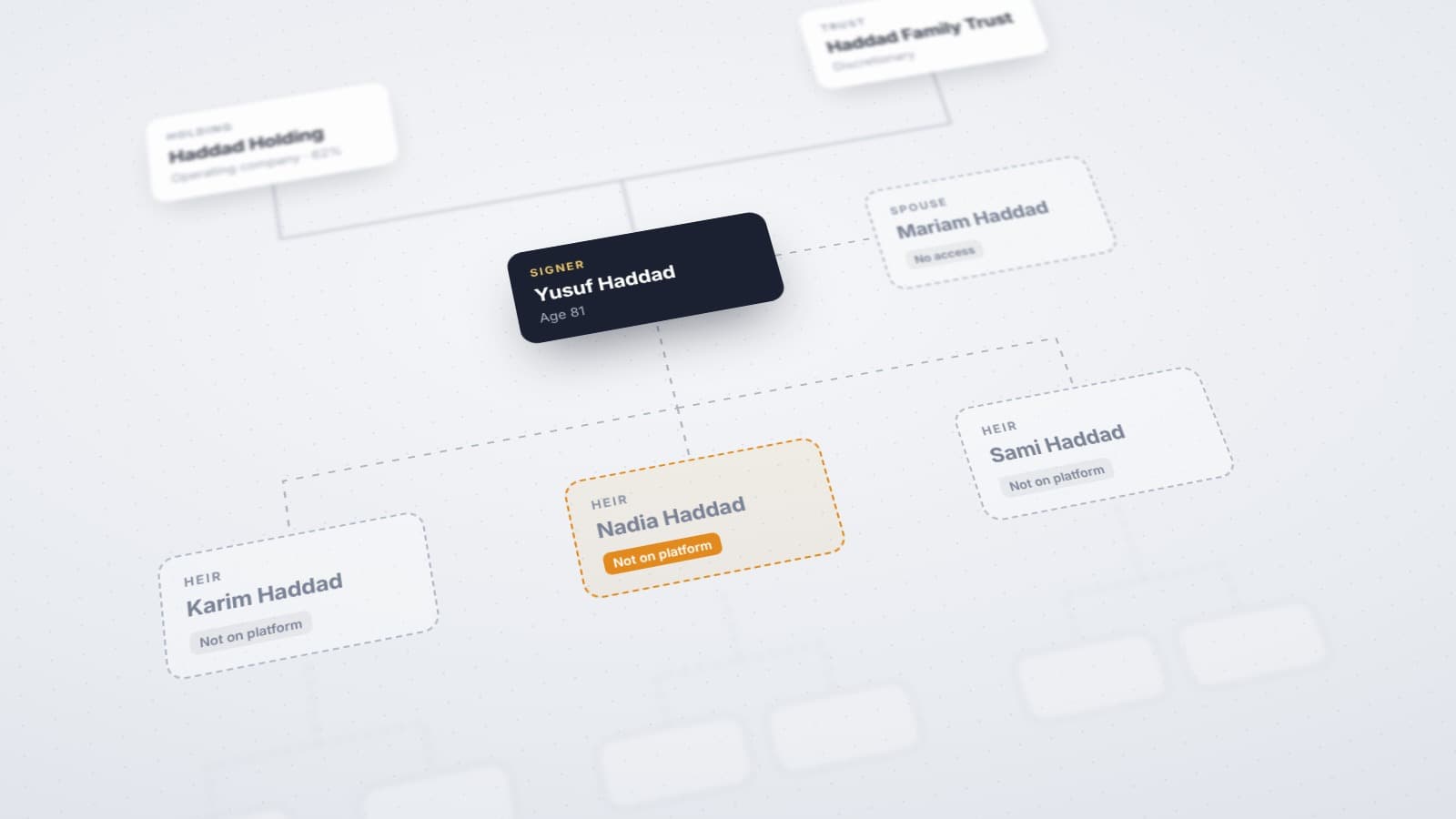
The absent stakeholder. Lena, Jonas and Helena's brother all have a stake in the plan but were never in the meeting. The children's gifts are estimated by their parents. Jonas's decision on the business, one of the variables the sale date depends on, has no date and no owner. The brother's 30% may affect whether and when a sale can proceed, and the plan does not mention him.
Each choice is reasonable in isolation. Together they produce a plan with a high probability of success and no answer to the only question the family actually asked.
Priority is a price, not a ranking
The usual fix is to ask the family to rank their goals. Ranking helps, but it is too blunt. It says the property matters less than the foundation. It does not say how much of the property a family would trade for keeping the company three more years.
Three features make a goal negotiable.
- A tier. Some goals are needs: the family's spending and a liquidity reserve that covers several years of it. Some are wants: the gifts and the property. Some are wishes: the foundation at full size. Tiers decide what is protected when cash is short.
- A range, not a point. A goal has a minimum and a target. A gift can be smaller now and larger later, a foundation can start at half its endowment, and a sale date can move inside a window.
- An owner. The person who can agree to change the goal, and who has to be in the room when it changes. The owner need not be the beneficiary, and not every stakeholder has the same decision rights.
With those three features in place, a plan can do something a list of goals cannot: it can price each goal in terms of the others. Academic work on goals-based wealth management has formalised this. Das, Ostrov, Radhakrishnan and Srivastav show how an investor with several competing goals can decide which to fulfil, partially fulfil or forgo, rather than following a strict sequence. In their framework, the asset mix changes each year with those decisions. Firms do not need the mathematics to use the idea. They need plans that show the trade-off before the family has to make it.
For the Webers, the question Helena asked has an answer once the goals carry tiers, ranges and owners. Until the company is sold, the same €22m of liquid assets has to fund the goals, the reserve and any financing costs. The figures below are illustrative, not a recommendation or a completed financial plan.
| Goal | Owner | Tier | Range (min to target) | If the sale moves from 2027 to 2032 |
|---|---|---|---|---|
| Family spending and reserve | Both | Need | €600k a year; €1.8m reserve (3 years) held in cash | Spending funded from dividends and portfolio income; reserve ring-fenced |
| Gifts to Lena and Jonas | Helena | Want | €2m to €3m each, 2027 to 2028 | Made in full in 2027–2028, unless the property is bought now with a loan |
| Lakeside property | Helena | Want | €5m to €8m, 2027 to 2032 | Waits until after the sale, or €5m now, leaving little free liquidity |
| Family foundation | Markus | Wish | €8m to €15m, 2027 to 2033 | Starts at €8m from the portfolio, topped up after the sale |
| Company stake | Both, subject to the co-owner's rights | Decision | Sell 2027 to 2032 | Two-thirds of the family's wealth stays in one company for five more years |
The cash arithmetic is what makes the table honest. The two gifts (€4m to €6m), the foundation's first €8m and the €1.8m reserve use €13.8m to €15.8m of the €22m. That is before taxes, transaction costs or a fall in markets. The scenario also assumes that the family's annual spending is funded separately in the cash-flow projection, from company dividends and portfolio income, and that taxes and existing commitments fit within the €6.2m to €8.2m that remains. The three-year reserve is ring-fenced against discretionary goals and replenished according to the family's agreed liquidity policy. The projection also has to stress-test a reduction or suspension of company dividends, since the family is choosing to keep a concentrated, illiquid stake for several more years. Paying cash for even the smallest property on top, with the gifts in full, would leave about €1.2m of free liquidity for up to five years. The property cannot simply be added as though the sale proceeds were already in the bank.
Borrowing looks like a way out. It is not. Suppose the family funds a €5m property with €2m from the portfolio and €3m borrowed against it, and the bank lends up to 60% of the value of the assets pledged, a common ceiling for a diversified equity portfolio. The €3m loan then needs €5m of the portfolio as collateral. With the gifts in full, only €4.2m is left to pledge, so the loan does not work unless the reserve is pledged too. With the gifts cut to €2m each, it works, and it leaves the same €1.2m of free liquidity as paying cash, plus €3m of debt, the interest on it and the risk of a margin call if markets fall. A bond-heavy portfolio would support a higher ratio and move these numbers, but not the conclusion: at any ratio below 100%, every euro borrowed locks up more than a euro of the portfolio. Borrowing against the portfolio does not create liquidity. It turns free assets into collateral, and a good system shows that before anyone signs.
The table's last row is the one most plans leave out. Keeping the company is not a neutral default. It carries a concentration risk that the family is choosing to hold, and that choice has a price as well.
The meeting can now start from a different sentence: "Keeping the company until Jonas decides means either waiting five more years for the property, or buying it now and running on about €1.2m of free liquidity until the sale. A loan does not change that. The gifts and the first €8m of the foundation fit either way, provided spending, taxes and existing commitments stay within what remains. Which would you rather give up?" That is a conversation the family can have. It is also one the advisor can lead.
The plan as a record of agreement
Suppose the Webers choose. The company stays until Jonas decides, with a deadline at the end of 2028 to revisit the decision, not an automatic sale date. The gifts are made in full in 2027–2028, the foundation starts at €8m, and the property waits for the sale. In most firms, that decision survives as a sentence in a meeting note and a changed assumption in a planning file. Six months later, neither says who agreed, what was traded, or what happens next if things go wrong.
That matters most at the worst moment. Plans are tested when markets fall, someone falls ill or a business sale slips. Those are the moments when families are least able to negotiate calmly, and when advisors face the most pressure to bend. A decision taken in a calm November meeting is worth more than one improvised in a crisis. That only holds if the November decision is on record.
A plan that works as a record of agreement holds four things:
- The decision. Which goals were set at which point in their range, and why.
- The parties. Who agreed, on what date, and who was informed but not consulted. Lena and Jonas might be informed of their gifts. Helena's brother might need to be consulted on the sale window, depending on the shareholder agreement.
- The cut order. What gives way first if the plan falls below a threshold. For the Webers: the property waits longer first, then the foundation's top-up moves, and the reserve stays ring-fenced.
- The triggers. The conditions that reopen the conversation. A fall in the company's valuation past a set level, a portfolio drawdown, a new offer for the company, or Jonas's deadline.
With those four in place, a bad quarter does not start a new negotiation. It opens a review against rules the family already chose. The advisor still judges the circumstances, but starts from a recorded agreement rather than a blank page.
What a planning system would have to do
None of the above needs new financial theory. It needs planning software that treats a family as several people with linked goals, rather than as one balance sheet with a wish list. In practice, that means seven capabilities.
- Goals with owners and beneficiaries. Each goal records who wants it, who benefits and who can view, propose or approve a change, including people outside the meeting.
- Tiers and ranges. Needs, wants and wishes, each with a minimum, a target and a time window, instead of a single amount on a single date.
- Trade-offs priced on demand. When one goal moves, the system recalculates the others and states the price in the family's terms: years, amounts, dates. It should not state that price as a change in probability.
- A view for each person. Each member sees their own goals, what they agreed to and what they are trading, within the permissions the family has set.
- Decisions as records. The chosen settings, the parties, the dates and the cut order are stored with the plan, not in a meeting note.
- Monitoring against the agreement. The plan is checked continuously, and a trigger raises an alert before the next review rather than at it.
- From alert to action. When a trigger fires, the advisor gets the agreed response, the people to contact and the steps to take, ready to confirm. An alert opens a review; it never changes a goal or sends a message on its own.
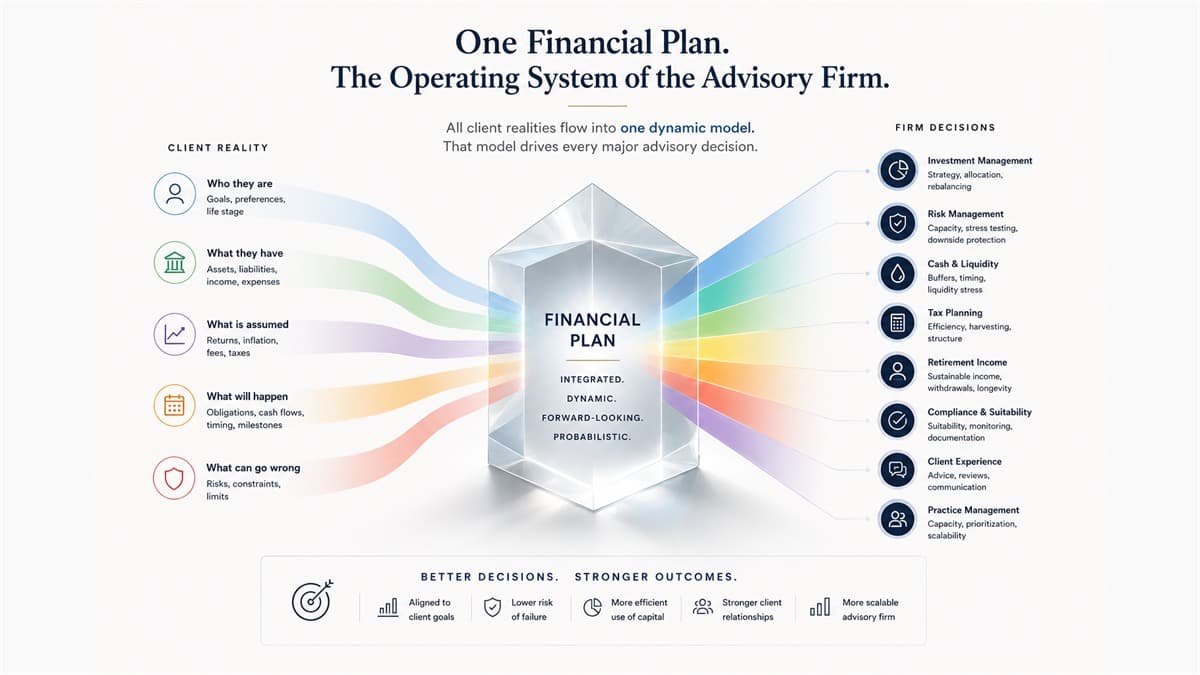
The first three change the meeting, the next two change the record, and the last two change what happens between meetings. A firm that has only the first three has better conversations. A firm that has all seven has plans that hold when they are needed.
How Pivolt approaches it
Pivolt builds planning into the same data model as the rest of the client relationship. A family's people, accounts, portfolios, CRM history and plan live in one place. Each goal in a Pivolt plan carries an owner, beneficiaries, a tier, a range and a time window. The planning engine that prices trade-offs is deterministic, and it is built and maintained by the same team as the platform. The AI Advisor sits on top of that engine and explains its results. It does not produce them.
Here is the Weber review, run again in three scenes.
In the meeting. Helena asks her question. The advisor types it as she said it: "If we keep the company until Jonas decides, what can we still do this year?" The AI Advisor turns the question into a scenario, and the advisor confirms it. The planning engine then moves the sale to 2032 and models the stake as illiquid until then. It holds the needs fixed and checks every goal against the cash available year by year. It returns two ways to close the gap: make the gifts and start the foundation at €8m now, with the property after the sale, or buy a €5m property now and run on about €1.2m of free liquidity until the sale. It also tests a loan against the portfolio. At a 60% loan-to-value, €3m of debt needs €5m of collateral that the family no longer has once the gifts are made, and the engine shows the interest cost and what a market fall would do to the loan. Finally, it shows the cost of waiting that the old plan ignored: two-thirds of the family's wealth in one company until 2032. Each figure comes with the assumptions behind it. The AI Advisor turns the result into plain sentences the family can read on screen. The conversation moves from "87%" to "which would you rather give up?".
After the meeting. The family chooses. The advisor confirms the decision, and Pivolt records it with the plan: the goal settings, who agreed and when, the cut order, and the triggers that reopen the conversation. The meeting note in the CRM links to that record instead of paraphrasing it. Markus and Helena each see their side of the agreement in their own reports. Lena and Jonas see only their own gifts. Jonas's deadline appears as a dated task for the advisor.
Six months later. The buyer lowers its offer by 20% after a weak quarter. Once the advisor records the revised offer, the valuation trigger fires. Pivolt flags the plan, shows which goal the family agreed would give way first, and calculates what that means: the property moves from 2032 to 2034, and the foundation's top-up shrinks. The advisor can see which inputs changed and which agreed priority produced the result. Pivolt prepares a next-best-action with the agreed response and a draft message for both partners. Nothing is sent and nothing changes until the advisor confirms. The call that follows is a check-in on a decision the family already made, not a negotiation under stress.
The same three guarantees apply throughout:
- Numbers come from the engine. Every figure the AI Advisor shows is calculated by the deterministic planning engine, with its assumptions visible.
- Actions need a person. No goal, record or message changes without an advisor's confirmation.
- Answers respect permissions. Each family member, and each person at the firm, sees only what they are entitled to see.
The question the plan should answer
A year later, the Webers sit down for their next review. The buyer's offer fell, and the lakeside property is now planned for 2034. Lena and Jonas have bought their homes in London and Singapore. The foundation has made its first grants from its initial €8m. Jonas decided earlier than expected to try a two-year role in the business, so the family brought its review forward instead of waiting for the 2028 deadline. The sale window is now 2030, after his trial, and the plan records it as a new decision linked to the old one, not as an edit that overwrites it.
Nobody in the room is surprised. The property moved because the family had already decided it would move first, and both of them had signed off on that. The review opens with what is still on track, not with what went wrong.
The 87% at the top of last year's plan said nothing about any of this. It told the family that their goals were probably affordable. It did not tell them what each goal cost in terms of the others, who would give way, or what would happen when the offer changed.
Family plans rarely fail only because the projections were wrong. They fail because the plan funded everyone's goals on paper and never asked who would give way. The first question of planning is not whether the family can afford its goals. It is whose goal gives way, and who agreed.
Sources
- Fidelity Investments, 2024 Couples & Money Study, press release (Feb 2024): nearly 9 in 10 say they communicate well or very well; 53% of non-retired couples disagree on retirement savings needed; more than a third disagree on upcoming major goals; 1 in 5 primary decision-makers resent handling finances alone. Survey of 1,794 couples by Ipsos, Oct 31 to Nov 22, 2023.
- Financial Advisor magazine, coverage of the 2024 Fidelity study: 47% disagree on risk tolerance (figure from the same study, reported here; not in Fidelity's press release).
- Piguet Galland, "Lombard loan guide": a diversified equity portfolio can support a loan of up to 60% of its market value; high-quality bonds up to 90%.
- Morningstar, "Uncovering Your Real Goals" and Morningstar UK, "How to set financial goals": 73% changed at least one top-three goal; 26% changed their top goal.
- Das, Ostrov, Radhakrishnan and Srivastav, "Dynamic Optimization for Multi-Goals Wealth Management", Journal of Banking & Finance (2022); summary, Santa Clara University.
- The Weber family, its goals and all figures in the table and scenes are hypothetical and illustrative.