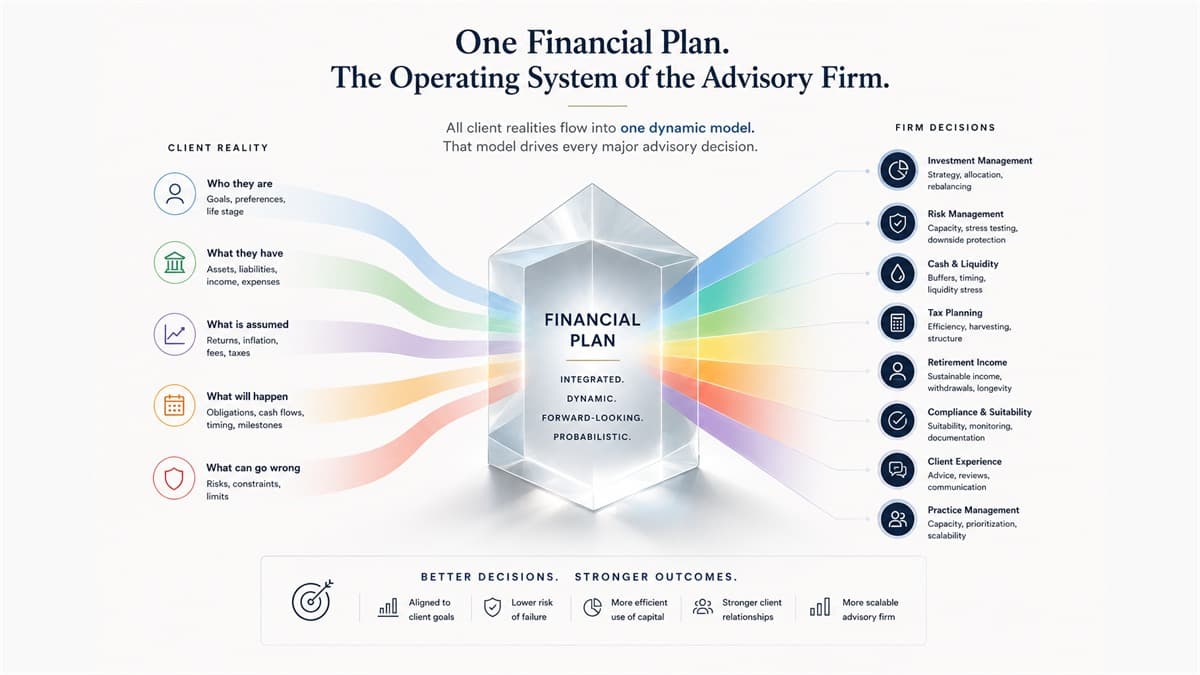
A financial planning engagement produces the most complete economic description of a client an advisory firm will ever hold. It states what the client owns and owes, which obligations are attached to that capital and when they fall due, the assumptions under which they can be met, and a measure of whether they are likely to be met at all. The work is intensive, expensive, and performed by the firm's most experienced people. In most firms it is also the last occasion on which that description is used.
This is not a criticism of planning. It is an observation about where planning sits. A plan is commissioned as a deliverable with a delivery date, and it inherits the lifecycle of a document: written, reviewed, presented, filed. A firm's operations run on a different clock — continuous, transactional, organised around accounts and instruments — and were never built to read a document. The most valuable thing a firm knows about a client is therefore the thing least able to reach the decisions taken about that client.
The gap is visible in any competent plan. Take one produced recently on Pivolt for a client of €21.3 million, forty-eight years old, retiring at sixty-five. It returns a 92 per cent probability of funding, five goals covered across their full payment series, and no depletion projected across a forty-four year horizon. The same model reports that real growth after fees is negative, and that the retirement income gap is not covered: at sixty-five, income meets roughly five-sixths of expenses. The platform declines to call the plan on track, recording its status as Tight, because one of four funding conditions fails. A system built to reassure would have printed the probability and stopped.
All of that is now known. In most advisory firms, none of it travels. The portfolio system holds the same €21.3 million and reports it against a market index. The CRM holds a risk label and a meeting history. The trading desk holds a mandate. What a firm knows about a client and what it operates on are two different objects, and only one of them is connected to anything.
The same holds in aggregate. A firm's accumulated planning work is the most precise description it possesses of its own future economics, and almost nowhere is it read that way.
Financial Planning Is the Firm's Richest Source of Client Intelligence
The distinction that matters is between facts and derived quantities. Custody systems, portfolio accounting, CRM and tax records hold facts, and hold them accurately. What they cannot do is combine those facts across time, because none of them holds the client's future obligations or the assumptions under which those obligations will be met.
Real return after fees and inflation is the plainest example. Deriving it requires the growth and yield of every asset class held, the fee actually applied, the allocation path the portfolio is expected to follow over decades, and a view on inflation, all resolved simultaneously across a horizon. Each component exists somewhere in a firm. Only the planning model holds them together, which is why the figure cannot be derived reliably anywhere else. Where it is negative, a projection showing net worth tripling in nominal terms is also a projection of a household becoming poorer.
The required return is a second such quantity: the rate at which capital must compound for a household's obligations to be met. It is the primary benchmark for judging whether a client's objectives remain achievable, and it emerges as a by-product of every planning engagement.
A third is the date at which household cash flow turns permanently negative — the point at which a portfolio stops accumulating and begins to be sold. Everything about the investment problem changes on that date. Sequence risk becomes a first-order exposure for most portfolios, liquidity acquires a schedule, and declines become partly permanent, because units sold into a fall do not participate in the recovery.
Simulation is what converts these point estimates into a statement about risk, and it deserves more weight than it usually receives. A projection built on single assumptions describes one future and implies a confidence it has not earned. A distribution built from thousands of paths describes the range a client is genuinely exposed to. The output that matters is not the median but the proportion of paths in which the obligations are met, which is the only integrated measure of adequacy an advisory firm produces.
Performance measurement evaluates a manager against a market; probability of funding evaluates a client against their own life. The two can move in opposite directions within the same year, through spending, through tax, through the arrival of an obligation nobody modelled. Firms report the first every quarter and calculate the second every few years.
Simulation also carries a discipline that presentation tends to lose. Percentile bands are a cross-section of outcomes at each age, not three coherent futures, and the tenth-percentile line is not a pessimistic scenario any client will live through. Read as scenarios, they imply a false precision about the shape of a bad decade. Read correctly, they describe dispersion, which is the thing that can actually be managed.
Most Advisory Decisions Begin Long Before Portfolio Management
Consider two clients holding identical portfolios of €21.3 million, in the same currency, at the same firm, both classified as moderate.
The first is the client described above: employed, seventeen years from retirement, with a property purchase of €1.5 million falling in a single year six years out, an income that ends abruptly at sixty-five, and roughly a third of the balance sheet in cash and near-cash. The second is seventy-one, retired on a pension that covers her expenses in full, holds no dated commitments, and intends her portfolio to pass intact to a foundation.
In a portfolio management system these two are close to indistinguishable. Almost every decision that matters to them differs.
The first client's capital call is a known claim with a date attached, amounting to six per cent of the portfolio in a single year. The liquidity to meet it either accumulates deliberately over the intervening years or is raised under pressure into whatever market exists when the deadline arrives. No policy expressed as tolerance bands around a strategic weight will produce it.
His income discontinuity is equally consequential. Earned income ends, portfolio income covers a little over half of expenses, and from that year the portfolio is being sold permanently. The second client never enters that regime, which means the same decline in markets carries a different meaning for each: an entry opportunity for a household still accumulating, and a permanent reduction in sustainable spending for one drawing on capital.
The cash weight illustrates the point most sharply. A third of a portfolio in near-cash looks like an obvious error under an allocation review, and for the second client it would be one. For the first, whether it is an error depends entirely on what that money is scheduled to do and when — a question the plan can answer and an allocation review cannot ask.
The de-risking path in his plan converts equities into fixed income while holding cash and near-cash close to a third of the portfolio throughout. Whether that is the right treatment is arguable. What is not arguable is that the mechanism performing the de-risking is not consulting the schedule that would settle the argument.
The Advisory Firm Already Depends on the Financial Model
Most advisory decisions ultimately depend on assumptions established during financial planning, even when the operational systems executing those decisions do not hold them. Where those systems were assembled separately, each function works from a private copy of what it needs.
Portfolio construction is the first. Assigning a client to a model portfolio is a judgement about horizon, withdrawal pattern and capacity for loss — a planning judgement, compressed into a category chosen at onboarding, when the firm knew least about the client, and revisited when regulation requires it.
Trading is where those assumptions become irreversible. A dated obligation is a liquidity requirement with an amount, a currency, a deadline, and an implicit tolerance for how much market risk the firm is willing to carry in the interval before it. Read from the plan, that requirement becomes a funding programme begun years in advance and sequenced to minimise realisation cost. Read from a mandate, it becomes an instruction arriving weeks before settlement, executed into whatever conditions prevail that month. The two produce materially different outcomes from identical information, and the information was available in both cases.
Rebalancing carries a similar burden. A rebalancing policy is a statement about how much drift a household can absorb before intervention is justified, and firms almost universally express it as tolerance bands set by asset class and applied uniformly across a book. The plan holds what those bands are meant to encode: the horizon the portfolio must survive, the obligations dated within it, and the point at which a deviation stops being noise and begins to threaten a funded goal.
A client eighteen years from any withdrawal and a client funding expenses from capital have different tolerances for the same drift, and one band cannot express both. Rebalancing also has a cost — turnover, spreads, realised gains — that plans model and policies rarely do, which makes every rebalancing decision a claim about the plan that is never checked against it.
Reporting is the most conspicuous case, because it is the part clients see. A quarterly report compares a portfolio to a market index and answers whether the manager did well. For most households, that is not the primary question. The plan already contains the benchmark that would answer what they are asking: the required return, the funded status of each obligation, the probability that the whole structure holds.
Reporting against markets produces a predictable pathology, in which clients are reassured in years when their position deteriorated and alarmed in years when it improved. A report drawn from the planning model inverts that, because it measures the client's position and not the market's.
Billing is quieter and equally consequential. The fee assumed inside a projection and the fee actually charged are maintained in different places, and few firms reconcile the two automatically. A small persistent difference compounds materially across a multi-decade projection.
Tax decisions are optimised against a single fiscal period. The plan holds decades of projected income, its composition, and the timing of disposals, and establishes when a client's income changes character — when earned income ends, when a concentrated holding is realised, when residence or entity structure changes. Whatever the jurisdiction, the value of a realisation decision depends on the years surrounding it, and a review conducted inside one year cannot see them. The argument is not about any particular tax code. It is about the horizon over which the decision is being optimised.
Compliance asserts a relationship between a portfolio and a client's circumstances. The evidence for those circumstances sits in the plan; the assertion is filed separately and updated on a different cycle. Firms tend to discover the divergence when someone external asks.
CRM holds the relationship and its history. The reason the relationship exists — the event ahead of it, the obligation that shapes it — is established during planning and survives in the CRM, when it survives at all, as free text in a meeting note.
Fragmentation persists for organisational reasons. Planning sits at the front of the relationship and is owned by advisers, while operations and investment sit behind it. What passes between them is conclusions — an allocation, a risk label, a target — and never the parameters that produced them, so the conclusion becomes a standing instruction disconnected from the reasoning that justified it. Systems were acquired in the order firms grew, with portfolio accounting first because it was mandatory and planning last, by which time the centre was occupied. Assumptions are cheap to copy and expensive to reconcile, so every function keeps a defensible local version and no mechanism exists to discover the divergence.
There is a cost to this that firms rarely see and clients always do. A client experiences an advisory firm as one institution, not as a collection of specialised systems. When the adviser has modelled the year income stops and the quarterly report arrives comparing a portfolio to an index, the client is not observing an integration problem. They are observing a firm that appears not to remember what it was told.
Underneath all of this is a governance vacancy. An assumption is a claim about the world that a firm makes on a client's behalf: what inflation will do over forty years, what a diversified portfolio should return, how long people live, what advice will effectively cost. These claims shape outcomes more powerfully than most decisions a firm deliberates over. They also have no owner.
Every firm has an investment committee. It meets, minutes its views, revises them, and can explain what it believed two years ago and why it changed. Nothing equivalent exists for planning assumptions, which are typically set once — by whoever configured the first template — and inherited thereafter by everyone who uses it.
The inflation rate embedded in a projection determines whether a client's future reads as a tripling of net worth or a decline in purchasing power. Fifty basis points of difference in that number, compounded across four decades, moves terminal real wealth further than most allocation decisions a committee will debate at length. Firms govern their view of markets rigorously and their view of the future informally, and the second view is doing more of the work.
The absence of ownership has a second effect. A firm can hold two clients whose plans embed contradictory views of the same world, with neither adviser wrong inside their own document. Nothing detects the contradiction, because detection requires a place where both assumptions are visible at once, and that place is precisely what a fragmented firm lacks.
The exposure this creates is invisible at client level. A wealth manager can be well diversified across its clients and heavily concentrated across its assumptions: one inflation view, one tolerance for illiquidity, one reading of the tax regime, applied to every household it serves. If the view is wrong, it is wrong everywhere at once, and no client-by-client review will ever surface it.
Such a firm does not lack the model. It lacks a single instance of it, and an owner for what the instance says.
Financial Planning Should Become Operational Infrastructure
Infrastructure is what other things depend on. The document does not become infrastructure; the model underneath it does. A plan is one expression of that model at one moment, the version rendered and presented and filed. The model is the continuing economic representation of the client, and it becomes infrastructure when it is maintained without interruption and when the functions already depending on its parameters read them directly instead of reconstructing them.
The first consequence is that assumptions acquire governance. A firm operating one economic model must decide, once, what it believes about inflation, real returns, fees and longevity, and must version those beliefs so it can state what it assumed three years ago and why it changed. This is a control requirement before it is anything else, and most firms cannot currently satisfy it for a single client.
It is also a management capability: a firm that knows its own assumptions can test the sensitivity of its entire client base to any one of them. Some platforms have begun to expose a related measure, reporting what proportion of a given plan rests on stated inputs instead of system defaults. The metric is not an industry standard, and it is useful for an unglamorous reason: it tells an adviser how much of the output in front of them was actually asserted by someone.
The second consequence is propagation. Changing a single planning parameter — a retirement date, a spending estimate, the timing of a liquidity event — alters the weighted return, the required return, the probability of funding, the liquidity available against dated obligations, the drawdown sequence, and the shape of the allocation path. Where those quantities live in separate systems, each adjustment is made by someone remembering to make it. Consistency becomes a behavioural achievement, sustained by conscientious individuals, and it degrades precisely when a firm grows.
The third consequence operates at the level of the firm, and it is the least explored. A book of financial plans is a description of the firm's own economics, expressed with more precision than anything in its management accounts.
Aggregated, the plans yield projected client outflows by year, which is a forecast of assets leaving built from clients' actual intentions instead of an assumed attrition rate. They yield projected liquidity events, which is a pipeline already inside the existing client base and usually rediscovered by accident. They yield an aggregate probability of funding across the book, which is a measure of whether the firm is delivering the thing it says it delivers, trackable over time and by segment.
Aggregation also supports capacity planning. Knowing which clients enter drawdown over the next five years tells a firm where its service model is about to be stressed, and the same exercise surfaces the other transitions that change what a relationship demands: succession in a family business, an inheritance arriving or leaving, the point at which a client's affairs begin to simplify. It supports segmentation by economic need instead of by asset size, which is a better guide to where attention should go.
One of the richest forward-looking inputs into a wealth manager's future revenue is contained in its clients' cash-flow projections. Market returns, pricing and net new business will weigh as heavily or more. But most firms forecast by applying a market assumption to last year's assets, and never consult the one input that reflects what their clients have already told them they intend to do.
A fourth consequence is scale. Planning delivered as craft scales with senior headcount, which is why most firms ration it to their largest relationships and offer everyone else a questionnaire. That rationing reflects the cost of producing documents, not a judgement that the remainder of the book has no obligations worth modelling. Planning maintained as infrastructure scales with clients.
A shared model imposes obligations of its own. It propagates errors as efficiently as corrections, which is why assumptions must be owned, dated and defensible, and why someone must be accountable when one changes. A firm that adopts a common model without building that accountability achieves consistency without accuracy, which is worse than the fragmentation it replaced.
Building an Advisory Platform Around Financial Planning
Pivolt was built on a single architectural decision: the financial model sits at the base of the environment, and CRM, portfolio modelling, rebalancing, trading, reporting and billing sit above it. What matters is not that these functions share an address. It is that the planning model is permitted to constrain them.
Liquidity shows what that permission changes. Planning conventionally treats liquidity as a label attached to a holding, or as a division between what can be sold and what cannot. Treated instead as a series of tiers defined by time to cash, each earning differently, it becomes something a projection can reason about.
Spending consumes those tiers in the order a household actually sells, which makes the year the model begins reaching into slower assets an output of the projection. Because the tiers earn differently, consuming one alters the return of what remains. The consequence worth an investment committee's attention is that a drawing household grows steadily harder to move: what survives a drawdown is both higher-returning and slower to sell, at the age when the capacity to wait is lowest.
Consistency follows from shared derivation. Paths produced by one engine from one set of inputs cannot contradict each other or the plan they describe, and a current portfolio and a proposed one can be examined through a single lens. Computed separately, they drift, and a firm ends up holding several unreconciled views of one client.
The same reasoning explains why a verdict should not collapse into a score. The model described at the outset returns 92 per cent and is not reported as on track, because a probability threshold is one condition among several, alongside whether obligations are funded across their full payment series and whether income covers expenses at the point income changes character.
What decisions of this kind share is a willingness to publish the inconvenient figure. A model consulted once a year can afford to be encouraging. A model read continuously by trading, billing, compliance and review cannot, because every function downstream inherits whatever it was allowed to omit.
This is where architecture earns its keep. A planning-only tool can model all of the above and then do nothing with it. Describing a household's liquidity and executing against it are one problem, separable only in firms where the description and the execution were bought from different vendors.
Suppose every financial plan a firm holds became unavailable tomorrow, and consider what would stop working. In most firms, nothing would. Portfolios would still rebalance. Invoices would still go out. Trades would settle, reviews would be scheduled, suitability files would remain complete. The absence would be noticed by clients at their annual meeting and by no system in the building. That is a precise measure of how much of a firm's understanding of its clients is load-bearing.
Plans of the quality now routinely produced establish things that ought to change decisions: that a portfolio is losing ground in real terms, that an income gap opens on a known date, that a large sum must be found in a particular year. Whether any of it changes a decision depends on something other than the quality of the analysis. It depends on whether the systems that will trade, bill, report and rebalance the client for the next four decades are able to read it. The intelligence is rarely missing. It is produced with considerable skill, delivered, and left in a folder while everything downstream carries on from a risk label chosen at onboarding.
Wealth management has spent twenty years perfecting its answer to the performance question. The relationship tends to be judged on a different one: whether the money did what it was meant to do. That second answer has been calculated with great care and filed. Both are already in the building. Only one of them is running the firm.