Ask a wealth management firm how much of its AUM belongs to clients over 75. Most can answer in minutes. Then ask how much of that AUM belongs to clients whose heirs the firm has met, can name, has recorded on the platform and has ever spoken to. The answer, where one exists, lives in advisors' heads, in a notes field, or in a will held by a lawyer the firm has never called.
That gap is usually framed as a commercial problem: engage the next generation, invite the children to a meeting, run an event. It is something larger. When wealth changes hands, every layer of the firm changes with it: who has legal authority, how the portfolio should be built, which suitability assessment applies, who receives which report, which fee schedule is billed, which relationship the firm is actually in. A platform that models the client as a single signer cannot see any of this until it happens, and when it happens, it sees only money leaving.
A transfer measured in trillions, retained in percentages
Cerulli Associates estimates that $124 trillion will transfer through 2048 in the United States, $105 trillion of it to heirs. More than half of that volume, $62 trillion, will come from high-net-worth and ultra-high-net-worth families that make up just 2% of households. The transfer is concentrated exactly where wealth managers concentrate their books.
What happens to those relationships is less certain than the volume, and the uncertainty is itself the finding:
- Capgemini's World Wealth Report 2025 found that 81% of the next-generation HNWIs surveyed plan to switch their parents' wealth management firm within one to two years of inheriting.
- Cerulli's own survey of affluent US investors, published in September 2025, found that only 27% of those expecting an inheritance would keep the benefactor's advisor, falling to 20% among those who had already inherited.
- EY's 2025 Global Wealth Research Report, based on nearly 3,600 existing wealth clients in 30 markets, finds much higher loyalty: 66% of Boomer, 82% of Gen X and 88% of Millennial inheritors say they are likely to keep the advisor or manager of the person they inherited from.
These figures are not contradictory. Cerulli asks affluent US investors whether they would keep the benefactor's advisor. Capgemini asks next-generation HNWIs whether they plan to leave their parents' wealth management firm. EY asks wealth management clients whether they plan to keep the advisor or manager of the person they inherited from. The sample and the question differ in each case, as do the generational groups and the relationships considered.
Read together, the studies point in one direction. The likelihood of retention depends, in part, on a factor most platforms do not measure: whether the firm has already built a relationship of its own with the person who will receive the wealth. Retention is not fixed by demographics, and a meaningful part of it is shaped by what the firm does before the event. And very few firms can say which of these situations describes their own book, because the platform holds no record of the people who will make the decision.
Two details sharpen the problem. First, the next transfer is often not to children. Cerulli counts $54 trillion in spousal transfers, nearly $40 trillion of it going to widowed women, frequently a spouse who was never the firm's point of contact. McKinsey projects that these spousal transfers could lift the share of that market's wealth controlled by women above 40% by 2035, up from about a third today. EY estimates that Boomers themselves could receive up to half of global wealth transfers in the coming decade. Second, families know they are not ready. In EY's survey, 65% of clients rate preparing for the estate transition as very or extremely important, yet 50% feel their family is underprepared, and 45% now find inheritance planning more complex, up from 31% two years earlier. Each of these is an information gap the firm could close years before the event, and almost none of it is recorded on the platform.
The client is whoever signs
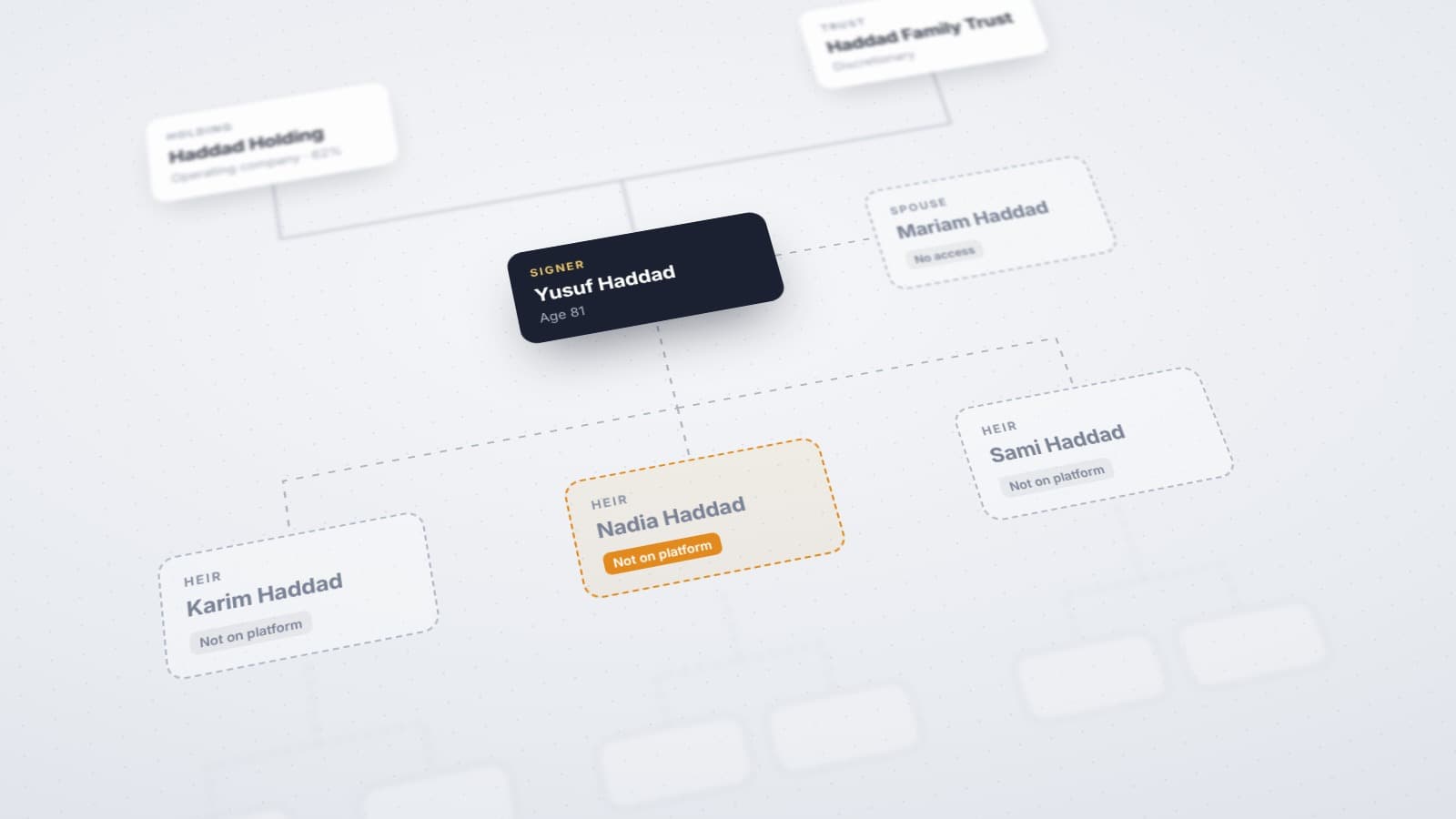
The platform cannot see heirs because of its data model, not through negligence. In most wealth systems the client is the party to a contract, the account holder or mandate signer, and every other record (positions, performance, suitability, fees, reports, CRM activity) points back to that one person. Heirs exist only as fragments: a name in a KYC field, a beneficiary designation held at the custodian, a daughter mentioned in old meeting notes, a will or trust deed that never enters the platform. None of them is connected to the positions they will one day own.
The most-watched metrics inherit the same blind spot. A firm can see that, say, 40% of its AUM sits with clients over 70, but not how much of it is covered by a known, engaged successor. As we argued in Your AUM Grew. Your Clients Are Leaving., the most-watched numbers are the ones best at hiding a decline. Here the demographic exposure is statistically predictable from data the firm already holds, even if no one can say when any single relationship will end. Whether it turns into lost revenue depends on the heirs, the structure and what the firm does first.
When the transfer comes, it lands on four layers of the firm at once, and each was built around the signer:
- Structure: who holds legal authority, through which entities, with what tax consequences.
- Portfolio: whose horizon, liquidity, jurisdiction and values the allocation serves.
- Relationship: who the firm knows, who can see what, who the advisor is.
- Economics: how the firm reports, bills and carries the revenue at risk.
The sections that follow take each layer in turn.
Layer one: the transfer is a sequence, not an event
Platforms that think about succession at all tend to model it as a single moment: the client dies, the accounts are retitled. In practice, the transfer unfolds over years, and authority changes hands several times before ownership does.
It usually begins with diminished capacity. The client is still the signer, but instructions start coming from a spouse, a child or an attorney-in-fact who is not on the mandate. It is the most dangerous stretch for the firm, and the one where elder financial exploitation becomes a live risk. Some regulators already require firms to seek a trusted contact for each account, but that contact is only a name in a field unless the platform knows what the person may and may not do.
Then comes death and estate administration: accounts frozen, valued and run by an executor with temporary, specific authority. Tax rules differ sharply by jurisdiction, from whether cost basis is stepped up at death to inheritance taxes and forced-heirship rules, and each shapes what heirs actually receive and when.
Finally, distribution, rarely a single step either. Assets often pass first to a surviving spouse and later to children, through holding companies, trusts and foundations where the roles that matter are settlor, trustee, protector, beneficiary, director and shareholder, each with different rights at different times.
The structural requirement follows directly. A platform cannot model succession with a static owner field. It needs roles with effective dates: who has authority, over which entity or account, from when, until when, and under which document. Without that, the firm cannot answer the most basic operational question of the transition, which is whose instruction it is allowed to follow today. We described the broader version of this problem in Family Governance Reimagined and Trust Structures at Scale: a structure that is mapped once loses its memory as it changes. Succession is the change that tests whether the map was ever alive.
Layer two: the portfolio was underwritten for someone else
Every portfolio encodes a person. Its horizon, liquidity buffer, tax position, currency, risk tolerance and exclusions were calibrated to the signer, often over decades. Much of what it holds is also history rather than intent: the founder's shares, a low-basis position nobody wanted to realise, a private fund commitment made through a friend, a real-estate vehicle that made sense when the client lived in that city. We called these Portfolio Fossils. Succession is the moment they all surface at once.
The heir is a different investor, along every axis that matters:
- Horizon. A 78-year-old's portfolio may be built for a ten-year horizon and an estate. A 45-year-old heir has forty years and a mortgage.
- Liquidity. Heirs often need cash early: a house, a business, a divorce settlement, the tax bill on the inheritance itself.
- Jurisdiction. Children of internationally mobile families frequently live elsewhere. An heir living abroad who inherits a portfolio booked elsewhere brings a new tax residency, new cross-border reporting obligations, and sometimes a new regulatory regime for the firm.
- Values and preferences. Capgemini found 61% of millennial and Gen Z HNWIs are already allocating to higher-growth asset classes and niche products, and 88% of advisors see stronger interest in alternatives among the next generation than among boomers.
The split itself is not arithmetic. Liquid positions divide pro rata. Illiquid ones do not. A private equity interest with unfunded commitments cannot be cut into thirds without the general partner's consent, and the capital calls keep arriving regardless. A concentrated holding in the family company might be exactly what one heir wants to keep and what another needs to sell. The same question is playing out across the economy: McKinsey expects about 6 million small and mid-sized businesses in the United States alone to change hands by 2035, and the viable ones alone represent up to $5 trillion in enterprise value. An equal split by value can produce three very unequal portfolios by liquidity, risk and tax. The questions we raised in The Asset Outside the Mandate and The Other Side of the Balance Sheet, about the operating company and about liabilities, apply here three times over.
Then there is regulation. When an heir becomes the holder of an investment relationship, the firm has to determine which suitability, KYC and other checks must be performed or updated, depending on the jurisdiction and the structure of the transfer. A beneficiary, an attorney-in-fact and a new account holder are not the same thing, and each carries different obligations. Where a new assessment applies, the assets an heir inherits may be unsuitable for them on the day they receive them. The benchmark that framed the parent's reviews no longer describes anyone's objective. Even performance history becomes a design question: does the heir's report start at zero on the transfer date, or does it carry the inherited track record and cost basis? Both answers are defensible. A platform that cannot hold both will force one by accident.
Layer three: two relationships transfer at once
The CRM is where the absence of heirs is most visible, and most easily excused. Meetings are logged against the signer. Next steps point to the signer. Heirs appear, if at all, as a related contact without history, without preferences, without a single recorded interaction. When the transfer happens, the firm meets its new client with the same information a competitor has: none.
EY's data shows how thin that engagement is today. Only 21% of Boomer inheritors, the group EY expects to receive up to half of transfers in the next decade, are highly satisfied with how their advisor engaged with the wealth transfer. None of this can be fixed in the six months after a death, during estate administration, when the heir is grieving, dealing with lawyers and being courted by every other firm in town. It can only be fixed in the years before, by a firm that knows who the heirs are and what they think.
There is a second succession running in parallel, and it is rarely discussed in the same breath. McKinsey expects about 110,000 US advisors, 38% of the total, to retire within a decade, and those advisors manage 42% of the industry's assets. Capgemini's global survey points the same way, with 48% of relationship managers expecting to retire by 2040. In many firms, the advisor who holds the family's history is on roughly the same timeline as the patriarch, and McKinsey finds that 32% of investors switch firms when their advisor leaves. If both the client and the advisor change in the same decade, everything the firm knows about the family that was never written into the platform leaves with them: the dynamics between siblings, the promise made about the family company, the reason a position was never sold.
Bringing heirs onto the platform early is not a matter of creating logins. It is a permissions problem with real stakes:
- Consent. While the client is alive and capable, the data is theirs. An heir can see only what the client authorises, and that authorisation must be recorded, scoped and revocable.
- Granularity. A daughter might see the consolidated family picture but not a sibling's trust. A son-in-law might join meetings but see nothing. Branches of a family may need to be kept confidential from each other.
- Privacy law. Under modern data-protection laws, every heir is a data subject with rights of their own, and a firm that processes their information without a basis is exposed.
- Channel. Heirs expect to engage on their own terms, often from other countries and time zones. McKinsey finds that only 14% of Gen Z would turn to a financial professional first with a money question, against 39% of baby boomers.
Built this way, the relationship with the heirs can start a decade before the transfer, and the firm can see at any time which families are covered and which are not.
Layer four: the economics of a foreseeable exit
The last layer is where the firm's own numbers change, and where the transfer is most often mispriced.
Reporting. After the split, each heir wants to see their wealth, not the family's. That requires reporting by beneficiary: look-through from each person, through every holding company, trust and fund, to the positions they economically own, at the percentages the structure defines. The family dashboard that served the patriarch becomes three or four views that must reconcile to the same underlying books. If the firm cannot produce them on day one, the heirs will get them from whoever can.
Billing. Fee schedules are usually built for the household: AUM is aggregated to reach breakpoints, and discounts are negotiated by the person who signs. When one $60 million household becomes three $20 million clients, every assumption in that schedule is reopened. Either each heir drops into a higher fee tier, which is a reason to leave, or the firm keeps the household breakpoint and accepts lower margins on smaller, more expensive relationships. As we discussed in CRM and Billing Alignment, fee logic disconnected from the relationship is rarely questioned until the invoice runs. The decision should be taken deliberately, per family, before the transfer, not discovered on the first bill.
Revenue at risk. Most firms think about client attrition as diffuse: a few relationships lost each year, for idiosyncratic reasons. Transfer risk is different. It is concentrated in the oldest households, which are often the largest. Its timing can be estimated across a book, though not for any single family. And it arrives in clusters: a single death can trigger the departure of a spouse, three children and an operating company's treasury account in the same quarter. This is the firm-level concentration we described in Your Clients Are Diversified. Your Firm Isn't., seen through demographics instead of markets. The distinction matters: the demographic event is predictable in aggregate, but the commercial loss is not inevitable. It depends on what the heirs decide, and that is the part the firm can still influence.
It can be measured. The useful metric is not AUM by client age, which most firms already have. It is AUM by age of the decision-maker, crossed with heir coverage: whether the successors are known, recorded, permissioned and engaged. That one cross-tabulation tells a firm how much of its revenue base is exposed, on what approximate horizon, and how much of the exposure is still addressable. It matters well beyond the advisory floor. Any acquirer of a wealth management business discounts a book whose revenue sits with clients in their eighties and whose heirs are strangers.
What it takes to put the heirs on the platform
None of the four layers can be solved inside a single module. A succession-planning tool that does not touch the portfolio produces a plan nobody executes. A CRM that records heirs but cannot permission them produces contacts nobody engages. A billing engine that does not know the household is about to split produces a surprise. The requirement is architectural, and it has five parts:
- People, not accounts, as the primary record, with every family member, entity and role on the same model as the positions, linked by dated relationships.
- Permissions as data: who may see what, granted by whom, from when, revocable, and enforced on every screen, report and answer.
- The transfer as a governed workflow, staged through capacity, death, administration and distribution, generating the right tasks in KYC, suitability, portfolio, billing and reporting at each stage.
- Position-level simulation of the split, including illiquid holdings, unfunded commitments, liabilities and tax, per heir and before the fact.
- Coverage as a firm-level metric, so that exposure is visible to leadership, not only to the advisor who happens to know the family.
This is where Pivolt is built differently. Clients, portfolios, plans, trades, rules, fees, reports and custodian data sit on one data model, front to back, rather than being stitched together through connectors. The family and holdings structure is mapped as part of that model, so look-through reporting by entity or by beneficiary comes from the same books as everything else. Workflow templates turn recurring procedures into governed sequences. And Pivolt's AI Advisor works across all of it, which matters here because succession is, by definition, a question that crosses every domain. It also speaks to the capacity problem in layer three: McKinsey estimates that AI-driven workflow automation has the potential to save advisors up to 20% to 30% of their time. That is an industry-wide estimate, not a promised result, but it describes the kind of capacity a firm needs to start heir relationships it has never had.
Three scenes show what that looks like in practice.
Finding the exposure. A head of advisory asks: “Which households over 75 hold more than $5 million and have no heir registered on the platform? Bar chart by advisor.” The answer draws on clients, portfolios and plans at once, and turns an anecdotal worry into a list with names, amounts and owners. A follow-up request schedules a family review with each of them, every invitation waiting for the advisor's confirmation.
Capturing the heir before the transfer. After a meeting, the advisor dictates: “Log my call with Omar Nasser: his daughter Leila will join the next review. She lives abroad.” The call is logged. The AI proposes the consequences instead of leaving them in a note: add Leila as a related person, with view access pending Omar's recorded consent; flag her foreign tax residency for the cross-border review; book the meeting. Nothing happens until the advisor confirms each step.
Simulating the split. Before a succession meeting, the advisor asks: “Simulate the Haddad estate split into three equal shares. Show each heir's allocation, liquidity, pending capital calls and fee tier.” The result shows what an equal split by value actually produces: one heir holding most of the illiquid private funds and the next capital call, another facing a higher fee tier, a third whose inherited allocation would breach the suitability rules attached to their profile. The advisor walks into the meeting with the conversation the family needs to have, not the one the spreadsheet suggested.
In each scene the same three guarantees hold. Every number the platform calculates comes from Pivolt's deterministic engine, not from the language model. Every action waits for a person's confirmation. And every answer stays within the permissions and approvals in force, which, for a family in transition, is precisely the point.
The outflow that could have been foreseen
On most platforms the transfer has no representation until it is over: no heirs on record, no permissions, no simulated split, no priced fee consequences, no visible exposure. When the event comes, the system does the only thing it was designed to do with a client who stops being one. It records an outflow.
The firms that keep these families will be the ones whose platform knew the heirs before the heirs needed the firm. That is not a campaign. It is a data model, and the time to build it is while the person who signs is still the one in the room.
Sources
- McKinsey & Company, US wealth management in 2035: A transformative decade begins, January 2026
- McKinsey & Company, The looming advisor shortage in US wealth management, February 2025
- McKinsey Institute for Economic Mobility, The Great Ownership Transfer: A New Era of Business Stewardship
- Cerulli Associates, Cerulli Anticipates $124 Trillion in Wealth Will Transfer Through 2048, December 2024
- Cerulli Associates, Many Investors Expect Inheritances, Yet Few Likely to Maintain Benefactor's Advisor, September 2025
- Capgemini Research Institute, World Wealth Report 2025, June 2025
- EY, How intra-generational transfers disrupt inter-generational strategies (2025 EY Global Wealth Research Report), May 2025