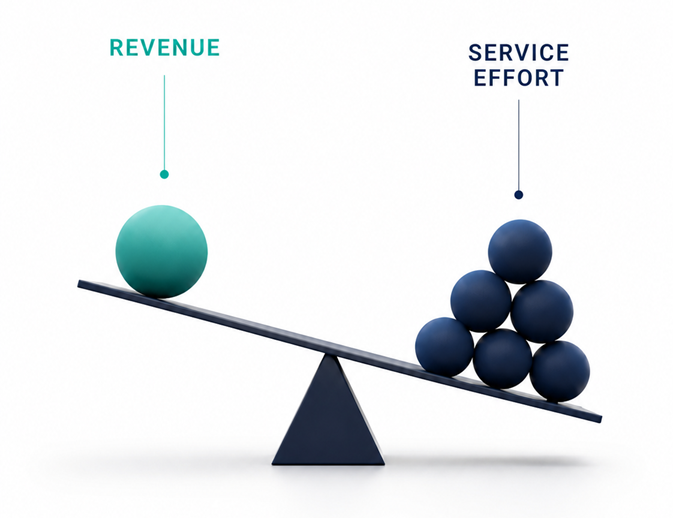
Most wealth management firms can tell you exactly how much revenue each client generates.
Far fewer can explain how much it actually costs to maintain that relationship.
This blind spot has existed for decades. Firms invest heavily in portfolio reporting, performance measurement, CRM systems, client portals, onboarding workflows and compliance processes. Yet the economics of the relationship itself often remain largely invisible.
A household generating significant annual fees may appear highly valuable until the underlying servicing effort is considered. Frequent meetings, complex financial planning requests, family governance discussions, estate planning coordination, reporting customizations and operational support can quietly consume hundreds of hours every year.
The result is a paradox. Firms may believe they are scaling profitable relationships while unknowingly increasing operational complexity faster than revenue.
As client expectations continue to rise, understanding relationship economics is becoming as important as understanding portfolio performance.
Revenue is one of the most dangerous metrics in wealth management because it creates a false sense of clarity.
A relationship generating $50,000 annually appears more valuable than one generating $25,000. On the surface, the conclusion seems obvious.
However, revenue alone reveals nothing about the resources required to sustain that income.
Some relationships operate efficiently. Client expectations are aligned with the service model, meetings are productive, planning discussions are focused and operational demands remain manageable.
Others evolve differently. Advisors become deeply involved in day-to-day matters, planning engagements expand, family dynamics introduce complexity and servicing requirements increase over time.
Two households with identical revenue may therefore contribute very different levels of economic value to the firm. The issue is not revenue. The issue is treating revenue as a complete measure of value.
The most overlooked component of profitability is often service intensity.
Every client interaction consumes resources. Meetings require preparation. Reviews require analysis. Planning sessions require expertise. Emails require responses. Compliance activities require documentation. Operational requests require execution.
Individually, these activities appear insignificant. Collectively, they determine whether a relationship contributes meaningfully to firm profitability.
Historically, most firms lacked practical ways to quantify this effort. Activities were recorded but rarely translated into economic information.
By assigning estimated effort values to recurring activities and combining them with advisor capacity and operating costs, firms can begin understanding the true economics behind relationship management.
| Relationship | Revenue | Service load | Economics | Signal |
|---|---|---|---|---|
| Miller Family | High | Moderate | Efficient | Stable |
| Rodriguez Family | High | High | Needs review | Review |
| Chen Family | Low | High | Margin pressure | Critical |
The real value emerges when operational activity is transformed into management insight.
Instead of reviewing isolated metrics such as revenue, meetings completed or tasks closed, firms can begin evaluating relationships through a broader economic lens.
A healthy relationship is not necessarily the one generating the highest fees. A healthy relationship is one where commercial value, service effort and advisor capacity remain balanced.
Some relationships may generate strong revenue but require an unsustainable level of service. Others may produce modest revenue today but operate extremely efficiently, making them attractive candidates for future growth.
Some advisors may appear highly productive from a revenue perspective while carrying unusually high servicing burdens. Others may quietly manage highly scalable client books with superior long-term economics.
By combining these dimensions into a single management framework, firms gain a more realistic understanding of how value is actually being created.
For decades, the industry focused on assets under management, investment performance and revenue growth.
Those metrics remain important. However, the next competitive advantage may come from understanding the economics of client relationships with the same rigor applied to portfolio analysis.
As firms continue expanding into financial planning, estate coordination, family governance, alternative investments and personalized reporting, advisor capacity becomes an increasingly scarce resource.
The firms that thrive will not simply be those that attract more assets. They will be the firms that understand where their time creates the greatest value.
Relationship economics provides a framework for answering that question. It helps leadership teams move beyond assumptions, beyond anecdotal observations and beyond revenue alone.
Because in modern wealth management, the most valuable relationship is not always the one producing the highest fee. It is the one creating the strongest combination of client value, advisor effectiveness and sustainable profitability.